
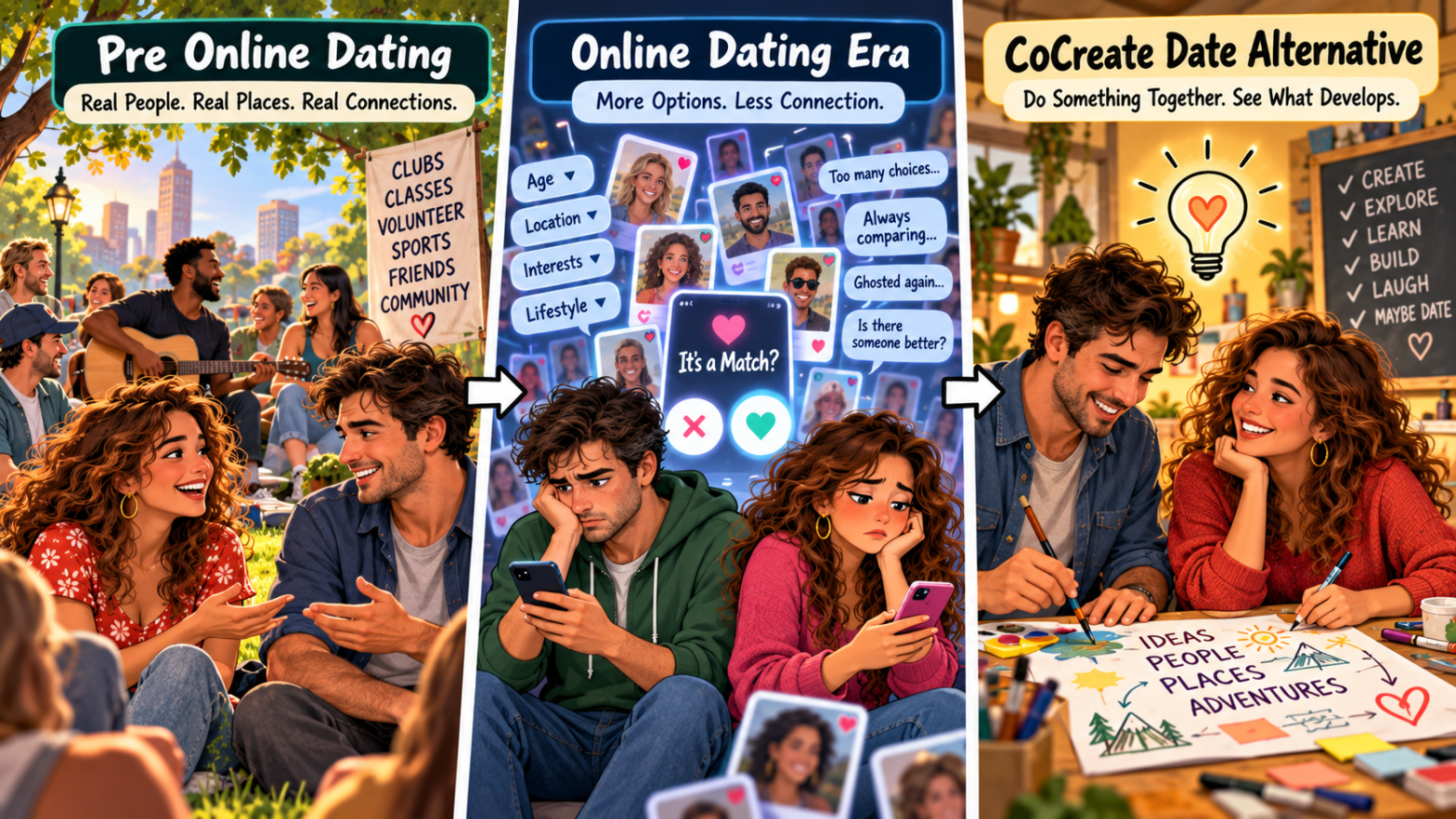
I’ve created this analysis of the problems with online dating with the help of my chatbot, Alex.
A research-informed critique of contemporary online dating
Online dating has unquestionably helped many people meet partners they would never otherwise have encountered. In the United States, about 30% of adults say they have used a dating site or app, and 10% of partnered adults say they met their current partner that way. About half of users describe their experiences positively. Pew Research Center
So the argument here is not that online dating is inherently bad or incapable of producing good relationships.
The more interesting question is whether the structure of online dating systematically encourages certain habits of mind that may work against the development of satisfying human relationships.
A useful way to organize those concerns is into nine broad problems.
1. The Marketplace Problem
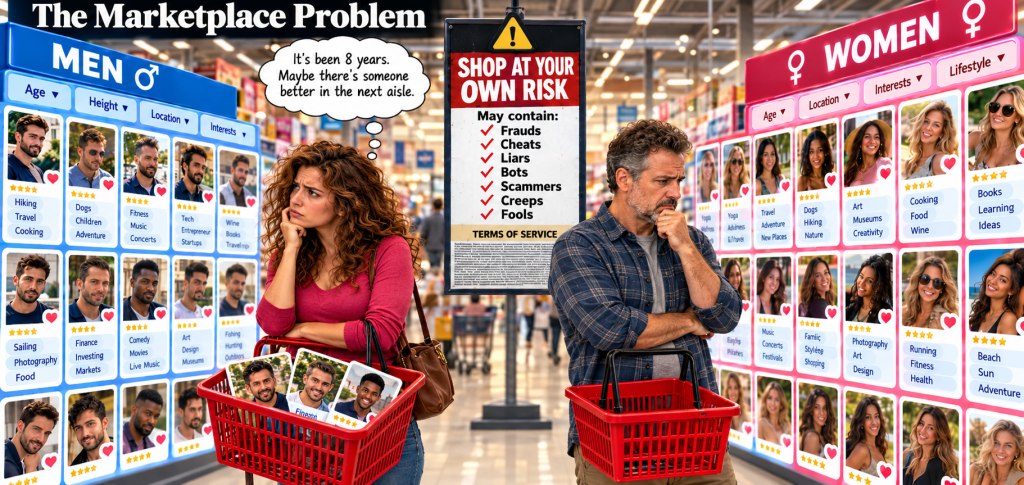
Online dating presents people in a format remarkably similar to a marketplace: photographs, attributes, preferences, filters, rankings, and a seemingly continuing supply of alternatives.
Researchers have actually documented this metaphor in users’ own descriptions. In one qualitative study, online daters spontaneously described themselves and others in marketplace terms and used strategies resembling consumer decision-making. The researchers called the phenomenon “relationshopping.” Sage Journals
This architecture can encourage a shift from:
“Could I build something worthwhile with this person?”
to:
“Is this the best person available to me?”
Those are fundamentally different questions.
Choice overload and the “better option” problem
One particularly relevant experiment found that as people evaluated more potential partners online, they became progressively more rejecting. Across three studies, the probability of accepting a candidate declined substantially as participants continued examining alternatives. The authors described this as a “rejection mindset” produced by perceived abundance. Sage Journals
This lends support to a concern many daters express intuitively: the continuing availability of alternatives may foster a sense that someone better might always be one swipe away.
That does not prove that dating apps make people abandon otherwise good relationships. But it does establish that large choice sets can change how people evaluate prospective partners.
The resulting psychology can include:
- maximizing rather than satisficing;
- fear of missing out;
- continual comparison;
- reduced willingness to tolerate ordinary imperfections;
- and difficulty feeling settled with a choice while alternatives remain psychologically present.
This may be one of the deepest structural differences between app-mediated dating and relationships that emerge in ordinary social life.
2. The Audition Problem
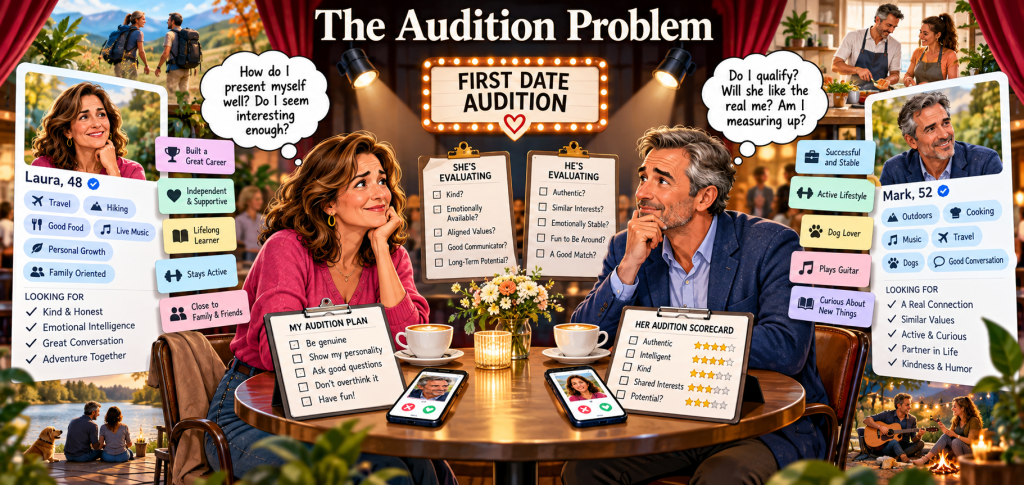
Online dating often asks two people to present themselves and evaluate each other simultaneously.
Profiles reward deliberate self-presentation. Messaging rewards conversational performance. First dates can consequently become extensions of the same process: two strangers exchanging histories, accomplishments, preferences, aspirations, and deal-breakers while each privately asks whether the other qualifies.
Research on online dating self-presentation shows that users actively manage the impressions their profiles create. This does not mean profiles are generally fraudulent; one classic study found that inaccuracies were usually small. But users strategically balanced truthful representation against the desire to appear attractive. Sage Journals
The problem is therefore subtler than dishonesty.
The medium encourages people to become their own marketing departments.
The resulting interaction can resemble an audition:
Here is who I say I am.
Here is why you might want me.
Here is what I want in a date.
Now tell me why I should want you.
That may be very different from discovering someone gradually while gardening, working, volunteering, making music, solving a problem, or simply spending repeated time together.
Online dating avanages people good at marketing themselves online over good people not good at marketing themselves.
3. The Abstraction Problem
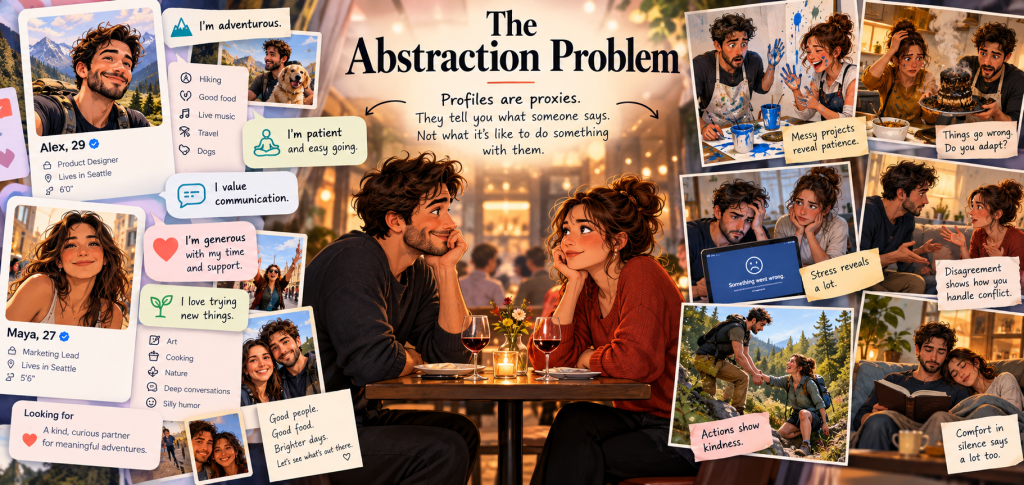
A dating profile provides information about a person and what they are looking for in a date.
It does not provide much opportunity to observe the person being themselves in a shared situation.
Profiles primarily offer:
- photographs;
- stated preferences;
- demographic information;
- autobiographical descriptions;
- humor;
- claims about values and personality.
Those can all be useful. But they are proxies.
Research on impression formation shows how heavily profile photographs and textual cues influence judgments before two people have ever interacted face to face. Sage Journals
Computer-mediated communication can also encourage idealization because people fill gaps in limited information with inference and projection. The broader “hyperpersonal” communication literature describes how selective self-presentation and reduced cues can sometimes produce impressions that are more socially desirable than ordinary face-to-face interaction would support. Sage Journals
This produces an epistemological problem:
We learn what people say about themselves before we learn what it is like to do something with them.
Someone can write:
“I’m patient.”
“I value communication.”
“I’m generous.”
“I’m adventurous.”
But those are claims.
Shared activity provides behavioral evidence.
How does someone behave when:
- the paint spills?
- the recipe goes wrong?
- the computer crashes?
- you disagree?
- neither person knows what to do next?
- one person needs help?
- silence lasts five minutes?
Those moments reveal different information.
4. The Premature-Romance Problem
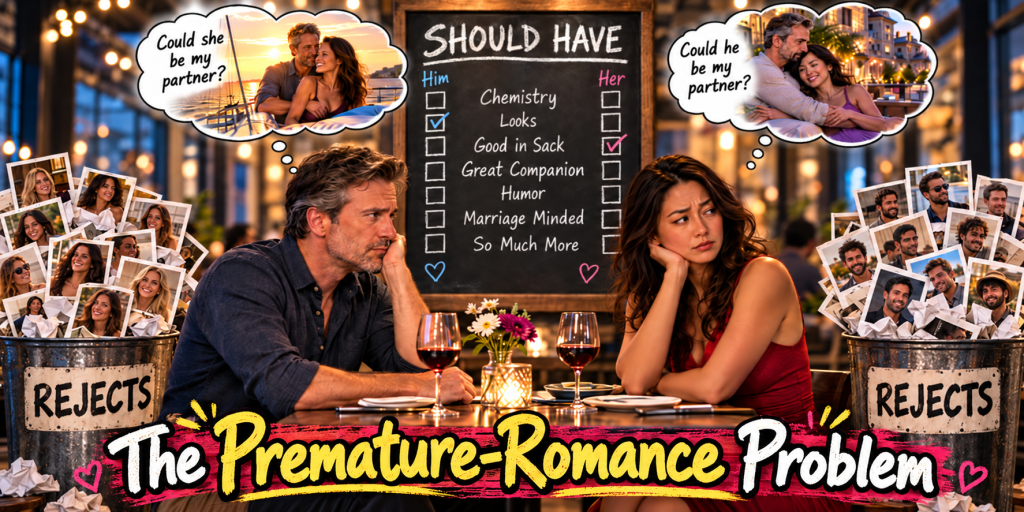
Online dating establishes romantic evaluation before much relationship exists.
Two strangers may meet for the first time already carrying a large question:
“Could this person become my partner?”
That can make every ordinary detail consequential.
Was there chemistry?
Was the conversation exciting enough?
Were they attractive enough?
Did they say something incompatible with my imagined future?
Some deep relationships begin with immediate attraction. Others emerge slowly through familiarity, admiration, friendship, shared activity, or repeated exposure.
Dating platforms naturally privilege the first path because the romantic question is present from the outset.
A consequence is that people who might have become valuable friends, creative companions, collaborators, or eventually lovers can be classified quickly as:
“No chemistry.”
And therefore discarded.
The failure condition becomes:
Not a romantic match = unsuccessful encounter.
That is an extraordinarily narrow definition of human value.
5. The Disposable-Connection Problem
Digital communication lowers the cost of exiting an interaction.
That has advantages. No one should be forced to continue unwanted contact.
But low-friction exit can also make relationships feel unusually disposable.
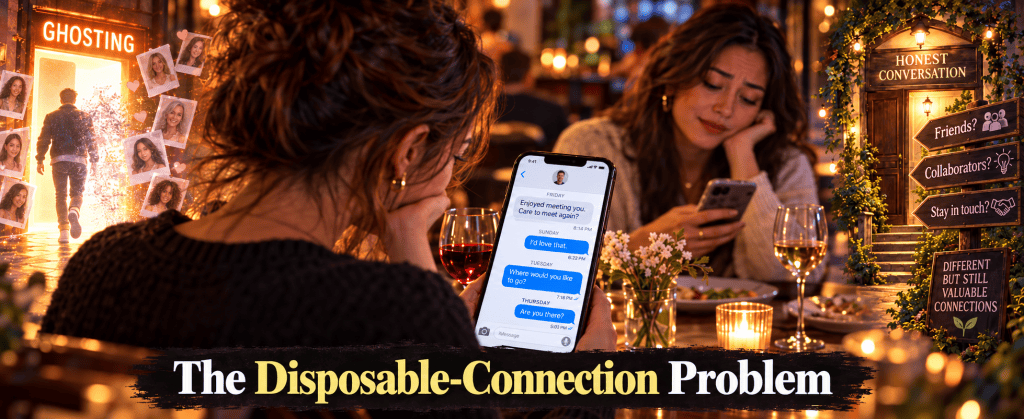
Research on online dating rejection finds that ghosting is common, including after substantial messaging. One recent study found ghosting was the most frequently reported form of online dating rejection in its sample. PubMed
Experimental work also suggests that ambiguous rejection such as ghosting can produce particularly negative emotional reactions compared with direct rejection. ScienceDirect
The broader cultural effect may be more significant than any single ghosting episode.
When replacing someone is easy, people receive less practice saying:
“I enjoyed meeting you, but I don’t think this is romantic for me.”
or:
“I don’t want the same thing you do, but I value knowing you.”
Online dating can therefore create an environment in which discarding a connection is easier than redefining it.
That matters because many worthwhile relationships are not the relationship initially imagined.
6. The Isolation Problem
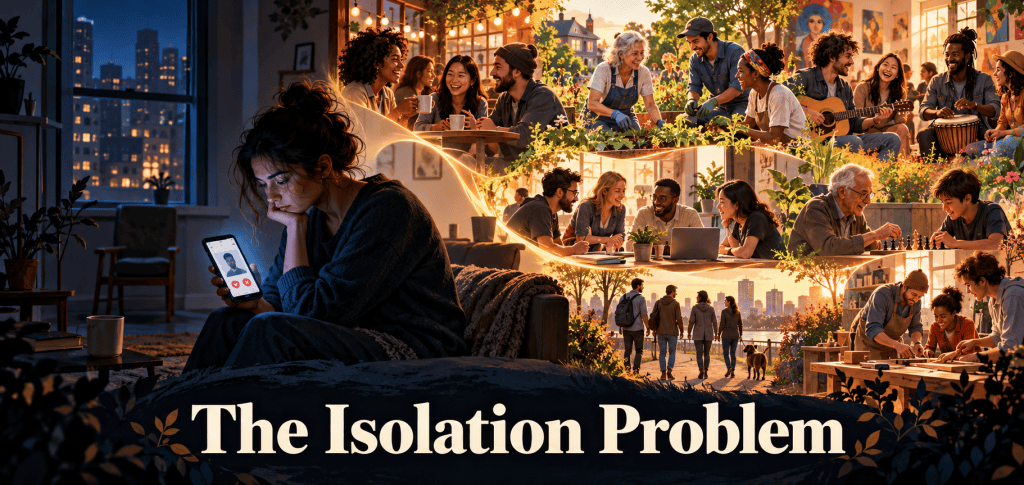
Dating apps offer a technological answer to loneliness:
Find the right individual.
But loneliness is not always a missing-partner problem.
People may need:
- friendship;
- repeated community contact;
- creative companionship;
- neighbors;
- colleagues;
- intergenerational relationships;
- people with whom to share ordinary activities.
A dating-centered culture can implicitly place an enormous burden on romance: one intimate partner is expected to provide companionship, emotional support, recreation, intellectual stimulation, sexual intimacy, family life, and often much of one’s social world.
Research on dating apps and psychological well-being deserves caution here because much of it is correlational. People who are lonely or distressed may be more likely to use dating apps in the first place. PubMed
Still, recent meta-analyses find that dating-app users, on average, report somewhat worse psychological health on measures including distress, anxiety, depression, loneliness, body concerns, and interpersonal sensitivity. The authors specifically caution that the available evidence does not establish that app use causes those outcomes. PubMed
The important conceptual point is simpler:
The answer to social hunger may be more relationships, not merely a better romantic search engine.

7. The Incentive Problem
Dating applications are commercial products.
Their users generally want to stop needing the product by finding satisfying relationships.
A platform, meanwhile, needs continuing users, engagement, subscriptions, or other forms of revenue.
That does not prove deliberate sabotage of successful relationships, and it would be irresponsible to claim that without evidence.
But it creates a legitimate structural question:
How perfectly aligned is the business objective of maximizing engagement with the user’s objective of becoming happily unnecessary to the service?
Research critiques have increasingly raised questions about dependency, engagement-oriented design, and the “datafication of intimacy.” Sage Journals
This is best treated as an incentive tension, not an accusation.
8. The Context Problem
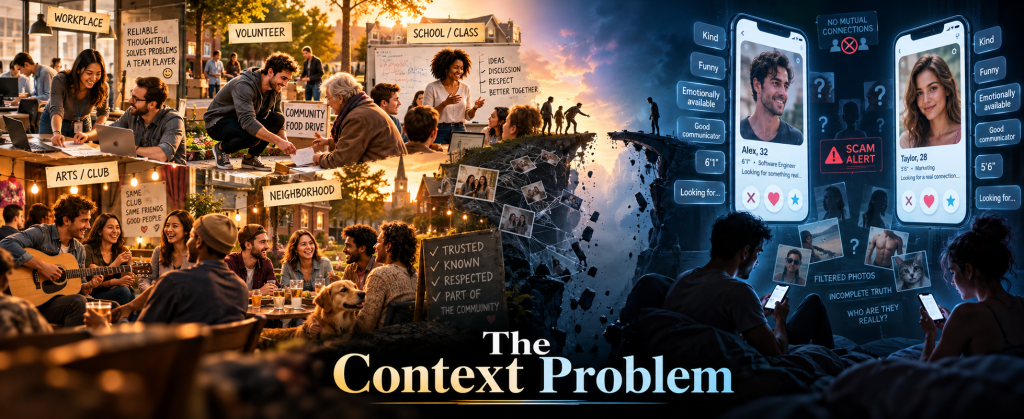
Historically, many relationships emerged from environments where people were already visible to one another:
- workplaces;
- neighborhoods;
- schools;
- religious communities;
- clubs;
- extended friendship networks;
- volunteer organizations;
- artistic communities.
Those settings supplied context.
Before considering romance, one might already know:
- whether someone keeps promises;
- how they treat other people;
- what they are like under pressure;
- whether others trust them;
- what absorbs their attention;
- how they contribute to a group.
Online dating deliberately solves a different problem: it lets strangers find one another.
That expands opportunity enormously.
But the price of expanded reach is often context collapse.
Two people may begin with little shared history, few mutual acquaintances, and almost no reputational information.
Pew data illustrate one practical consequence: 52% of U.S. online dating users surveyed said they believed they had encountered someone attempting to scam them. Pew Research Center
The problem extends beyond scammers.
Even sincere people begin largely as unverified self-descriptions. A profile can tell you what someone believes about themselves, what they want you to know, and how they hope to be perceived. Some users also misstate objective facts such as age, height, photos, relationship status, or intentions. But even when every factual detail is accurate and the person is acting in good faith, claims such as “I’m kind,” “I’m emotionally available,” “I’m funny,” or “I’m a good communicator” remain largely untested until you have had enough shared experience to observe how those qualities actually show up in behavior.
9. The Wrong-Skills Problem
Online dating rewards a distinctive collection of skills:
- choosing flattering photographs;
- writing an appealing profile;
- messaging cleverly;
- flirting;
- interpreting ambiguous signals;
- creating immediate rapport;
- performing well on first dates.
Those are real social skills.
But they are not necessarily the same skills required for maintaining a durable relationship:
- reliability;
- patience;
- emotional regulation;
- repair after conflict;
- reciprocity;
- generosity;
- compromise;
- respect for autonomy;
- tolerance of boredom;
- capacity to build something over time.
Someone can become highly skilled at dating without becoming particularly skilled at relating.
This distinction may explain some of the fatigue users describe. They repeatedly practice relationship initiation rather than relationship development.
Pew’s 2023 survey found highly mixed experiences: 53% of users characterized online dating positively, while 46% characterized it negatively, and significant numbers reported harassment, unwanted contact, scams, and other adverse experiences. Pew Research Center
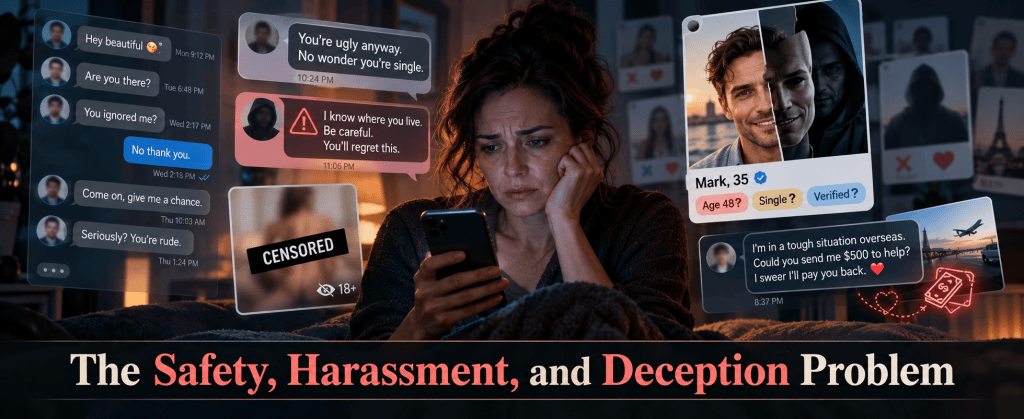
A Tenth Problem: Safety, Harassment, and Deception
This issue sits somewhat apart from the philosophical critique because it involves direct harms rather than merely questionable incentives.
Pew found that among Americans who had ever used online dating:
- 38% reported receiving unsolicited sexually explicit content;
- 30% experienced continued contact after expressing disinterest;
- 24% had been called an offensive name;
- 6% had received threats of physical harm;
- and 48% had experienced at least one of those four behaviors. Pew Research Center
Women under 50 reported substantially higher rates of several of these experiences. Pew Research Center
Research on profiles also confirms strategic misrepresentation, although classic studies found that much of it was relatively modest rather than wholesale fabrication. Sage Journals
These problems should not be confused with the broader philosophical critique, but they reinforce the difficulty of beginning intimate relationships among strangers without shared social context.
What Online Dating Does Well
A fair analysis should also acknowledge why these systems became popular.
Online dating can:
- expand the pool of people someone can meet;
- help people in geographically or socially restricted circumstances;
- make intentions more explicit;
- help people with niche preferences find one another;
- facilitate relationships across communities that might otherwise never intersect;
- provide opportunities for people who find traditional approaches difficult;
- and, very importantly, actually produce long-term relationships.
One in ten partnered American adults surveyed by Pew in 2022 said they met their current partner online. Among partnered adults under 30, the figure was 20%. Pew Research Center
The critique is therefore not:
“Online dating doesn’t work.”
It is:
“Online dating solves the discovery problem in ways that may create other problems in how people perceive, evaluate, and relate to one another.”
The CoCreateDate Alternative
CoCreateDate does not need to present itself as the replacement for online dating.
It can challenge one underlying assumption:
Perhaps the best way to learn whether another human being belongs in your life is not to evaluate them first. Perhaps it is to do something alongside them.
That “something” need not be a joint project.
One person might:
- write while another paints;
- practice guitar while another sews;
- code while another writes poetry;
- learn watercolor together;
- make separate origami figures;
- sit beside each other working independently.
The essential change is from face-to-face appraisal to elbow-to-elbow experience.
Instead of asking:
“Are you good enough for me?”
the encounter can begin with:
“What are you making?”
And eventually perhaps:
“What might we make possible in one another’s company?”
A CoCreate Date can therefore have a very different failure condition.
If there is no romantic chemistry, the date need not have failed.
Perhaps:
- a painting was made;
- a chapter was written;
- an idea was improved;
- something new was learned;
- a friendship began;
- or two people simply spent a satisfying afternoon creating in company.
That is a much higher floor for a human encounter.
The Central Contrast
The deepest distinction may ultimately be this:
Online dating tends to ask:
Who should I choose?
CoCreateDate asks:
What happens when we spend time creating near one another?
The first emphasizes selection.
The second emphasizes experience.
One begins with judgment and hopes relationship follows.
The other allows relationship—romantic or otherwise—to emerge from shared life.
References and Further Reading
- Pronk, T. M., & Denissen, J. J. A. (2020). A Rejection Mind-Set: Choice Overload in Online Dating. Social Psychological and Personality Science, 11(3), 388–396.
Particularly relevant to choice overload and increasing rejection as users encounter more options. Article - Heino, R. D., Ellison, N. B., & Gibbs, J. L. (2010). Relationshopping: Investigating the market metaphor in online dating. Journal of Social and Personal Relationships, 27(4), 427–447.
Directly examines marketplace thinking and the objectification of potential partners. Article - Finkel, E. J., Eastwick, P. W., Karney, B. R., Reis, H. T., & Sprecher, S. (2012). Online Dating: A Critical Analysis From the Perspective of Psychological Science. Psychological Science in the Public Interest, 13(1), 3–66.
A foundational review of the promises and limitations of online dating. Article - Toma, C. L., Hancock, J. T., & Ellison, N. B. (2008). Separating Fact From Fiction: An Examination of Deceptive Self-Presentation in Online Dating Profiles. Personality and Social Psychology Bulletin, 34(8), 1023–1036.
Examines strategic inaccuracies in online dating profiles. Article - Ellison, N. B., Hancock, J. T., & Toma, C. L. (2012). Profile as promise: A framework for conceptualizing veracity in online dating self-presentations. New Media & Society, 14(1).
Useful on curated self-presentation and users’ understandings of authenticity. Article - Walther, J. B., & Whitty, M. T. (2021). Language, Psychology, and New New Media: The Hyperpersonal Model of Mediated Communication at Twenty-Five Years. Journal of Language and Social Psychology, 40(1), 120–135.
Useful for understanding selective self-presentation, idealization, and computer-mediated intimacy. Article - van der Zanden, T., & Schokkenbroek, J. M. (2024). Multiple Facets of Rejections in Online Dating: Exploring Types, Reasons, and Impact. Cyberpsychology, Behavior, and Social Networking.
Examines ghosting and other forms of online rejection. PubMed record - Cela, H., & Wood, G. (2026). A systematic review and meta-analysis of the mental health correlates of swiping-based dating app use. Communications Psychology.
Recent review finding associations with several adverse psychological outcomes while emphasizing that causation remains unresolved. PubMed record - Sharabi, L. L., Ou, L., Von Feldt, P. A., & Parsons, T. D. (2026). Dating app use, psychological health, and psychological well-being: A systematic review and quantitative meta-analysis. Computers in Human Behavior, 177, 108879.
Meta-analysis of 23 studies examining psychological health and well-being among dating-app users. Article - McClain, C., & Gelles-Watnick, R. (2023). From Looking for Love to Swiping the Field: Online Dating in the U.S. Pew Research Center.
A nationally representative overview of use, attitudes, success, harassment, scams, and safety perceptions. Pew report - De Ridder, S. (2022). The Datafication of Intimacy: Mobile Dating Apps, Dependency, and Everyday Life. Television & New Media, 23(6).
Examines algorithmically organized dating and the broader cultural consequences of treating intimacy as data. Article - Bhattacharya, S. (2025). Window Shopping Humans in the Dating Store: What User Bios Tell Us About Online Dating. Journal of Creative Communications, 16(2).
A recent theoretical treatment of commodification, self-objectification, and consumer logic in dating apps. Article
A note on evidence
Some of these claims are more firmly established than others.
There is reasonably direct evidence for choice overload, strategic self-presentation, rejection dynamics, harassment, scams, and marketplace framing.
Claims about loneliness, declining commitment, FOMO, or apps making people less capable of relationships require more caution. Much of that literature is correlational, and people who are already lonely, anxious, dissatisfied, or rejection-sensitive may be more likely to use dating apps heavily. The strongest version of the argument is therefore not that apps cause all these problems, but that their design can amplify or reward psychological tendencies already present in human beings. PubMed
That distinction would make a CoCreateDate critique substantially more credible, in my view.

