Featured

Won’t You Try a New Way of Dating

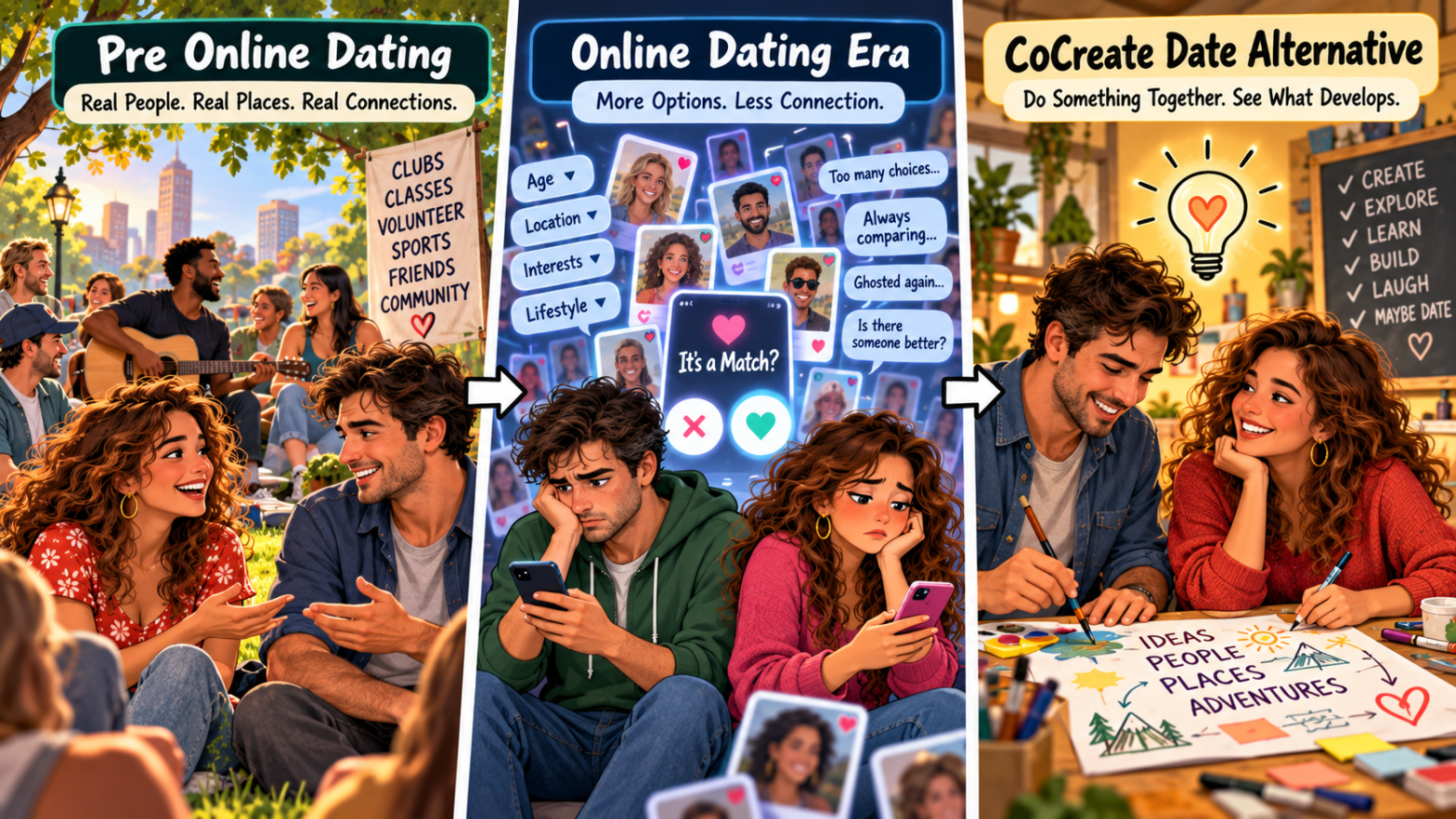
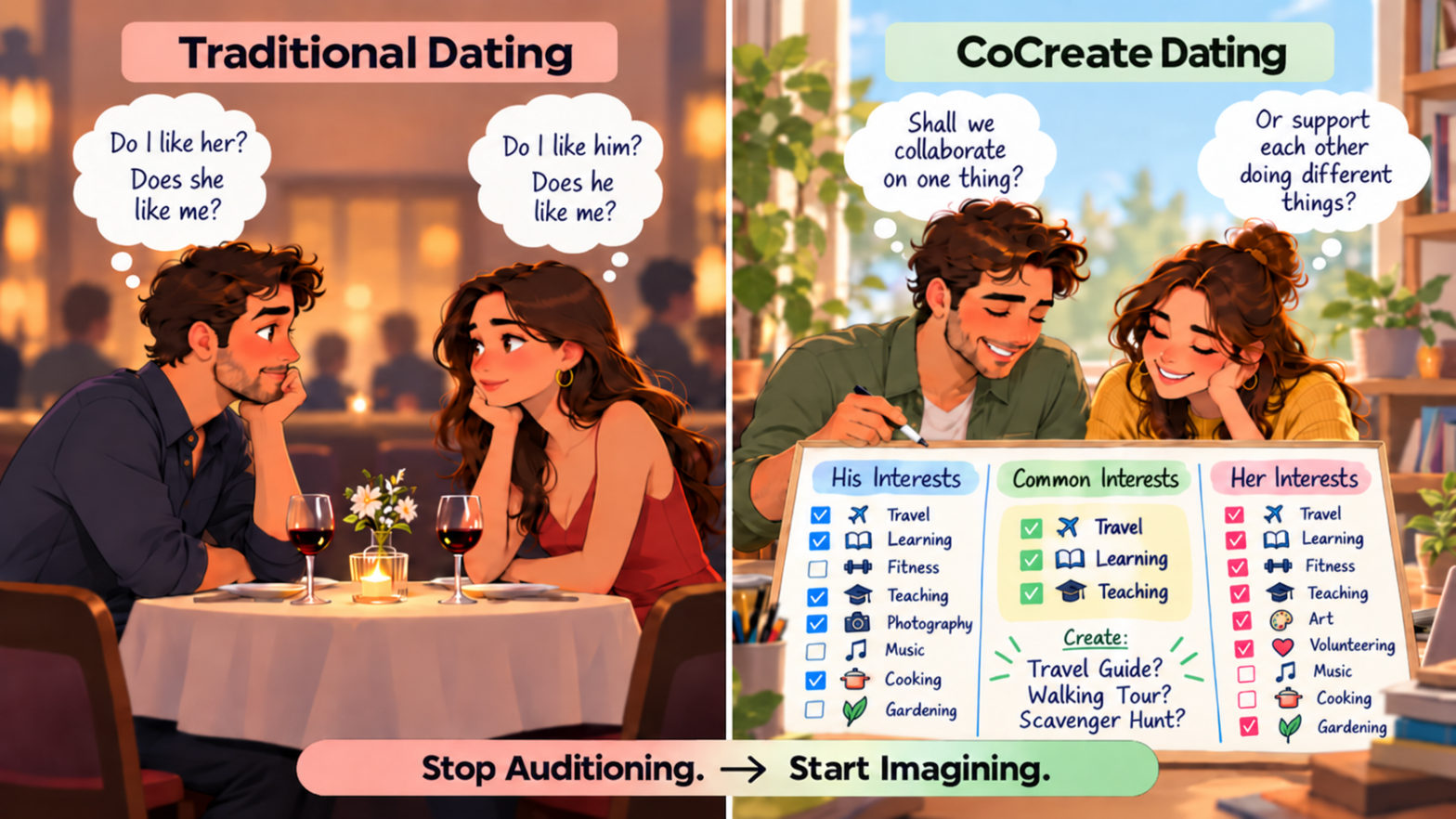
Stop Auditioning → Start Imagining

Traditional dating often puts two people across a table asking silent questions:

Do I like them? Do they like me?

CoCreate Dating changes the question.

Instead of making yourself or the other person the entire focus of the date, put something interesting between you: an idea, a project, a problem, a skill you want to learn, or simply two different things you each enjoy doing in the same place.

Maybe you discover that you both love travel, learning, and teaching. Instead of merely talking about those interests, you might ask:

Could we make a walking tour? A travel guide? A scavenger hunt?

Or perhaps you don’t want to work on the same thing at all. One of you writes while the other paints. One studies while the other designs a game. You keep each other company, exchange ideas when useful, and see what develops.

The point isn’t to manufacture romance.

It’s to create a setting in which you can see more of the person than you might see across a dinner table. How curious are they? Do they listen? Do they encourage? Can they laugh when something goes wrong? What happens when neither of you knows the answer?

And if romance doesn’t develop, the date doesn’t have to be a failure.

You may have made something. Learned something. Helped one another. Found a collaborator. Made a friend. Or simply spent a good afternoon in interesting company.

CoCreate Dating replaces “Are you the one?” with a much more open question:

What might we create — and what might we become to each other along the way?


What is the mission of CoCreateDate.com?

To help people form richer relationships by creating alongside one another instead of beginning with mutual evaluation.

Is CoCreateDate.com a dating website.

No. We promote an idea and a philosophy. We encourage experimentation and report on how others have deepened relationships through cocreation. And we offer resources you can use to signal you are a CoCreator on your dating profile, at work, or even just walking around. But we arev not a matching platform. This is not a business; it is a passion project of one man, who you can learn about here.

Is this only for singles?

Absolutely not. We promote connection through creation rather than merely consumption. We would like to see more cocreation for all types of people, not just couples pursuing romance. And couples who are already together might refresh their relationship by making a date to co-create.

Featured

What If I’m Not Creative?

One of the first objections I hear to the idea of a CoCreate Date is:

“But I’m not creative.”

This usually means creativity has been defined too narrowly.

You may be imagining creativity as painting a picture, writing a novel, composing music, or inventing something nobody has ever seen before.

Those things are creative. But they are only a small part of creativity.

If you prepare a meal while your partner works on a sculpture, you have created something another person can enjoy today. If someone writes a play, you might help produce it, design the poster, build the website, sell tickets, arrange the venue, or tell people why they should see it.

You do not have to be the person holding the paintbrush to participate in creation.

Creativity Is Often Practical

Creation includes making something new, but it also includes improving, organizing, solving, adapting, and combining.

You might:

Continue reading “What If I’m Not Creative?”
Featured

Let’s Make a Date to CoCreate CoCreateDate.com

CoCreateDate is still in the process of being invented.

I’m looking for people of all ages, backgrounds, relationship statuses, and skill sets who are interested in helping shape what this idea becomes.

That might mean:

  • helping define the philosophy and language,
  • designing or building the website,
  • creating graphics, writing, music, video, or other media,
  • researching what helps people form meaningful connections,
  • experimenting with CoCreate Dates in the real world,
  • developing etiquette and best practices,
  • finding ways to introduce the idea in workplaces, libraries, maker spaces, schools, communities, and online,
  • or simply trying it and telling us what worked, what didn’t, and what you would change.

You do not need to be single.
You do not need to be looking for romance.
You do not need to be an expert in anything.

You only need to be curious about whether people might get to know one another better by creating alongside each other instead of evaluating each other from across the table.

Bring an idea. Bring a skill. Bring a question. Bring a criticism. Bring yourself.

Let’s work on creating CoCreateDate together.


Your next step: Fill out our questionnaire by clicking here.


Featured

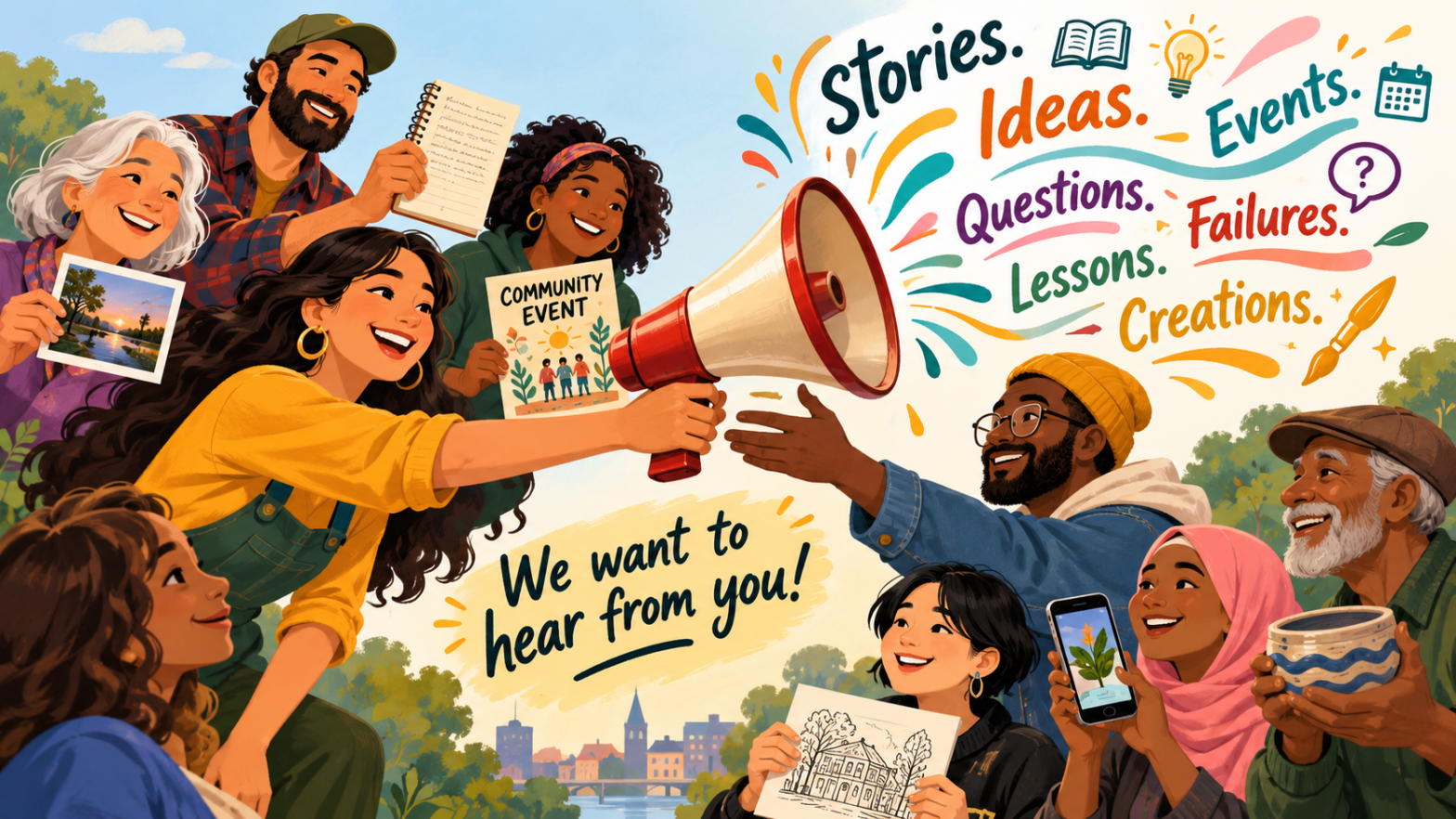
Share Your Thoughts and Experiences

We have ideas about what CoCreate Dating might become, but we do not want this to be a finished philosophy handed down from above. We want to learn from people who try it, question it, improve it, reject parts of it, and take it in directions we have not imagined.

So please share what you are learning. Submit your ideas in writing to: Brooke.T.Allen (at) Gmail.com

The three contributions we most want right now are:

  • Stories from actual CoCreate Dates — good, bad, awkward, surprising, or inconclusive. What did you try? What happened? What did you learn?
  • Lessons and improvements. What worked? What did not? What would you change next time? What advice would you give someone trying it for the first time?
  • Events and opportunities. Are you organizing an event that might interest CoCreate Daters? Perhaps you’ve organized a gathering, a workshop, a meetup, a library event, a maker-space session, an online experiment, or anything else others might want to join?

In addition to those, there are many other contributions we’d like to publish here.

We’d also love to hear about:

  • CoCreate Date ideas
    Activities people can try together: writing, painting, cooking, coding, gardening, photography, music, volunteering, game design, learning projects, repairs, planning, and anything else you think might work.
  • Experiments
    Try a variation and report back. Different lengths, settings, structures, levels of collaboration, or ways of pairing people.
  • Failures and awkward moments
    What felt forced? What was confusing? What went badly? What would you never do again? Failure may teach us more than success.
Continue reading “Share Your Thoughts and Experiences”

Online Dating: An Analysis

I’ve created this analysis of the problems with online dating with the help of my chatbot, Alex.

A research-informed critique of contemporary online dating

Online dating has unquestionably helped many people meet partners they would never otherwise have encountered. In the United States, about 30% of adults say they have used a dating site or app, and 10% of partnered adults say they met their current partner that way. About half of users describe their experiences positively. Pew Research Center

So the argument here is not that online dating is inherently bad or incapable of producing good relationships.

The more interesting question is whether the structure of online dating systematically encourages certain habits of mind that may work against the development of satisfying human relationships.

A useful way to organize those concerns is into nine broad problems.


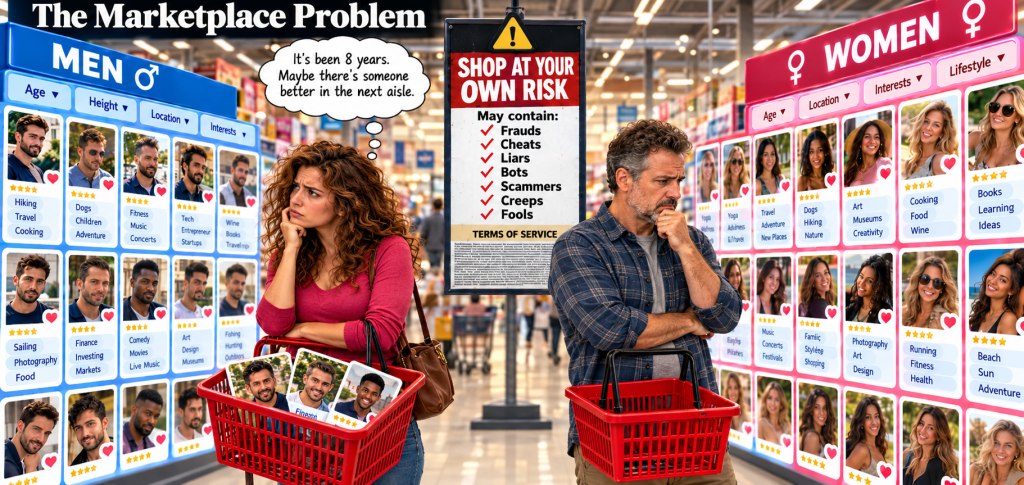
A humorous illustration depicting a marketplace dilemma, featuring two aisles labeled 'Men' and 'Women' with a variety of profiles displayed. A woman stands thoughtfully in front of the 'Men' section, reflecting on her options, while a man is seen next to the 'Women' section. Both are holding shopping baskets. The sign overhead warns shoppers to 'Shop at Your Own Risk' and lists potential issues like frauds and scammers.

1. The Marketplace Problem

Online dating presents people in a format remarkably similar to a marketplace: photographs, attributes, preferences, filters, rankings, and a seemingly continuing supply of alternatives.

Researchers have actually documented this metaphor in users’ own descriptions. In one qualitative study, online daters spontaneously described themselves and others in marketplace terms and used strategies resembling consumer decision-making. The researchers called the phenomenon “relationshopping.” Sage Journals

This architecture can encourage a shift from:

“Could I build something worthwhile with this person?”

to:

“Is this the best person available to me?”

Those are fundamentally different questions.

Choice overload and the “better option” problem

One particularly relevant experiment found that as people evaluated more potential partners online, they became progressively more rejecting. Across three studies, the probability of accepting a candidate declined substantially as participants continued examining alternatives. The authors described this as a “rejection mindset” produced by perceived abundance. Sage Journals

This lends support to a concern many daters express intuitively: the continuing availability of alternatives may foster a sense that someone better might always be one swipe away.

That does not prove that dating apps make people abandon otherwise good relationships. But it does establish that large choice sets can change how people evaluate prospective partners.

The resulting psychology can include:

Continue reading “Online Dating: An Analysis”